
How to Restore (not Renovate) the Character of a Period House

Notice the word choice: restore, not renovate. There's a fine line between the two, and it's the difference between a period house that still feels authentic and one that's been quietly stripped of what made it special in the first place.
This isn't a post about paint colours or curtains, useful as those are. It's about the fabric of the house itself: the fireplaces, floors, plasterwork, windows, staircases, and doors that define its period. Before touching any of it, you need to understand what was originally there.

Image credit: @among_thebarley_fields
Restoring a period house requires a delicate balance between the past and the present. It is totally possible to enhance your living experience by incorporating modern amenities without compromising the house’s character. The aim should be to blend modern fixtures harmoniously with the house's historical features while always preserving your property's unique identity. The main thing to remember is to be as authentic to the building as possible.
Start by researching your house
Before you plan anything, find out as much as you can:
What period is it? Tudor, Georgian, Victorian, and later houses each have distinct characteristics, and what's "correct" for one is wrong for another.
What's original, and what's been altered? Look closely at existing features for signs of loss or alteration.
Who can tell you more? Parish records, local libraries, online census records, and a heritage consultant (who can quickly identify what's original and what isn't) are all worth exploring. Neighbours are an underrated resource too: chances are they've faced the same restoration challenges and can save you time.

If your house is listed, check the National Heritage List for England. Listed status protects both interior and exterior, and you'll need Listed Building Consent for most work affecting the building's special interest, including internal walls and ceilings. Your local authority's conservation officer is the first point of contact, and it's worth involving a designer or architect experienced with period and listed properties before you submit an application.
Once you understand what the house originally looked like, you can decide what to restore, replace, or leave alone. Original plasterwork, fireplaces, and tiling are almost always worth restoring; they're often inexpensive relative to the difference they make, and a strong market of reclaimed and original period features exists to help.
Make the most of your Fireplace
A fireplace was the focal point of a room long before it was decorative, it was the only source of heat and, with candles, of light. That's worth keeping in mind even if yours is now purely ornamental.

If open fires aren't permitted in your area, don't assume the fireplace itself has to go. Keep the surround in place and consider a bioethanol insert, or a wood-burning stove if the flue allows (check the environmental implications and current regulations before committing).
If the original chimneypiece is gone, you'll be choosing between a reproduction and a salvaged original. The Georgian Group's advice applies well beyond Georgian houses:
A chimneypiece should be genuinely appropriate to the room, not oversized or overly elaborate for the space. Its scale was historically dictated by the room's importance, not by decorative ambition. Many modern reproductions get this wrong, and are often left in bare pine rather than painted, unlike the originals.
Worth knowing: there's no evidence that Georgians left wooden chimney pieces unpainted. They were painted to match the woodwork or to imitate stone or marble. The same holds for Victorian pine surrounds; waxed or varnished pine wasn't the historical finish.

Original Floors
Original floors are among the most beautiful things a period house can offer and are often among the most restorable. If you're considering underfloor heating or insulation between joists, get professional advice first; wooden floorboards need careful handling either way.
Floorboards cut before the 1830s (before machine cutting became standard) were hand-cut and irregular. Knowing which era your floor belongs to will tell you what "correct" actually looks like for your house.

Original wooden floor in an Arts and Crafts house
Victorian encaustic tiles, common in porches and hallways, should be checked for cracks, chips, and signs of damp or mould before any restoration work begins.

Image credit: Pinterest Period Home and Interiors
Plasterwork
Lath and plaster often can't be saved once water damage has set in. If you spot loose plaster on a wall or ceiling, get a professional assessment before deciding what's salvageable.

Dado Rails, Picture Rails, Cornicing & Ceiling Roses
While you're doing any restoration work, be sure to protect any original cornices and ceiling roses. Remember, old plasterwork doesn’t always handle vibrations well. Ceiling roses can be carefully removed, stored, and then reinstalled. If you think your cornice or ceiling rose might need restoration, it is worth contacting a professional to conduct a thorough survey, including checking for potential water ingress points above and below the ceiling. Where the cornice or ceiling rose cannot be saved, a specialist can make a template to reproduce it.
Just a quick note on ceiling roses. Do not automatically assume you must add a ceiling rose to every room in a period house. Only reinstate a ceiling rose when you are confident that there was one originally. Less important rooms, such as servants' rooms, attic rooms, and less important bedrooms, would have been more plainly decorated. It's usually pretty straightforward to see whether there used to be a rose on the ceiling, as you can tell from the unevenness where the ceiling has been repaired.
According to the Victorian society:
"You can usually tell if a rose has been removed, from unevenness where the ceiling plaster has been patched. When reinstating ceiling roses, align them with the centre of the chimneybreast (which may not be the geometric centre of the ceiling)."
Where the dado rail is still in its original place and in reasonably good condition, it will be worth restoring. If the dado rail has been previously removed, and you'd like to replace the original, remember the following:
If you can see where it has been removed, replace the rail at the same height. To determine the original height, look for bumps or old fixing holes in your plasterwork.
Do not place the dado rail too high; this can make the whole room feel wrong. Some carpenters will give you a specific height or advise you to divide the wall height into three and fit the rail a third of the way up the wall. I've even heard someone say that you should measure the back of your chairs to determine the height of your chair rail. The simple answer to this question is that there is no set rule. There cannot be a "one size fits all" rule for where to put your chair rail because it depends on the ceiling height. It's all about proportion. The dado rail should fit proportionally into the room, so let your ceiling height guide you.
As I said in a previous post (A Quick Guide to Dado Rails), before the 18th century, the function of the dado rail was to protect expensive wallcoverings from chairs that were kept against the wall when they weren't in use. These days, the point of the chair rail is not functional but aesthetic: to add interest to a room. It divides the wall space and makes it easier to experiment with colour, texture, and pattern.
Historically, in the early 18th century, panelled walls, the dado, and the picture rail were often painted in one colour. I love using the same colour on the whole wall, from the skirting board to just below the cornice. When you paint everything, the skirting, the dado, and the picture rails in the same colour (using an eggshell in the same colour on the woodwork), it makes the room appear bigger. It creates a calm, elegant atmosphere with a contemporary feel.

Clever use of wallpaper between the dado rail & picture rail by @overdale_house
Windows
Period windows were mostly made of wood, which deteriorates over time. You cannot simply replace or alter the windows of a period house without considering the correct period and style; you'll remove too much of the house's character. Replacing or altering historic windows can have a significant effect not only on the building itself but also on the overall visual appeal of the street and the local area. Before replacing the windows in your period home, you should explore repair options. This approach helps preserve the building’s heritage and can be more cost-effective.
If restoring your windows is impossible and they need to be replaced, contact an experienced professional for advice. Many dedicated professionals can repair and restore historic windows while respecting the building and its period. If your house is listed, you must consult your local planning department before undertaking any work to determine if Listed Building Consent is required.

If you want to replace the single glazing to prevent heat loss and noise, you can install slim double-glazed units while keeping the original sash window. The hidden weights on the side of the window should also be adjusted, as the double-glazed panels are heavier than the single ones.
The Staircase

This is an essential feature in most period houses and is always worth preserving or restoring!
Larger medieval houses would have had a staircase, but in other, less important houses a ladder was sometimes used. Not all Tudor houses had feature staircases, and many were enclosed by walls. Dog gates were often found in Elizabethan houses to stop dogs from getting upstairs.
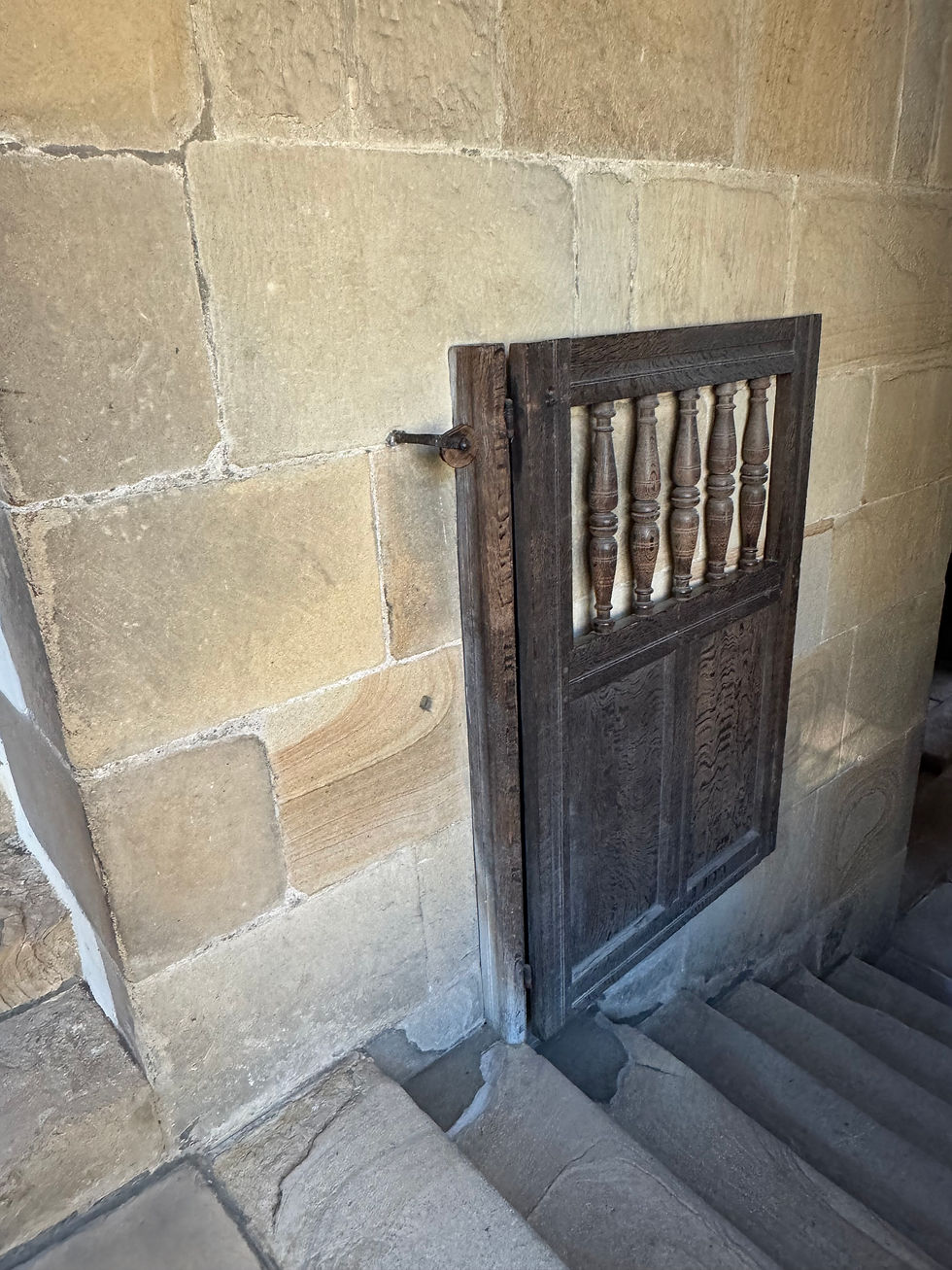
Example of a dog gate at Haddon Hall
Stone and wood were the primary materials for staircases in Georgian houses, with stone used by wealthier homeowners as it was much more expensive than wood. From the beginning of the 18th century, wood was most commonly used for staircases and for steps, balusters, and handrails in ordinary houses. Pine was the cheapest and would have been painted in the widely used "stone" colours. More expensive elm or oak would have been left unpainted to show off the expensive wood. Throughout the 18th century, Mahogany was very popular for handrails.
Most grand Regency houses had light, airy staircases with thin iron balusters and dark wooden handrails with skylights fitted above the stairs.

Image credit: @oliverthorntonhome
The elegant iron-and-wood Regency staircases fell out of favour during the Victorian period, and carved or turned wooden balustrades became popular. The area under the stairs was often boxed in and panelled to replicate Elizabethan staircases.
"There is no standard position for stairs in Victorian houses. In larger terraced housing they were usually positioned up against the party wall towards the rear. Guests could admire the elaborate balustrades and posts, yet the owner only had to pay for one side and when out of sight upstairs it could fall back to a cheaper, simpler design."
- Trevor Yorke

Image credit: @among_thebarley_fields
Doors
Where previous owners have removed or changed the internal doors, and you have to replace them in a period house, it is worth remembering that doors varied by function within the same house. Attic and service doors would have been plainer than reception room doors.
"Georgian doors were invariably painted, and never left bare or varnished. Some humble internal doors, away from the principal rooms, may have occasionally been left unpainted in Georgian homes, but even these would have been given repeated layers of wax polish."
- The Georgian Group
Exact period-matched doors are hard to find; a reclaimed door of the right era is more realistic, and a good carpenter can adjust it to fit. For listed properties or principal reception rooms, it's worth commissioning a specialist to replace them rather than improvising. Check existing doors carefully too: many original panelled doors were covered with hardboard during the 1960s and are still underneath.
Front doors matter as much as windows for a house's character. If the original is gone, source something genuinely in keeping with the period, down to the door furniture. On Georgian hardware specifically, the Georgian Group notes that before 1810, external door fittings were rarely polished brass; they were almost always cast iron, painted black, regardless of what many reproduction suppliers now suggest.

Original door in an Arts and Crafts House

Front doors matter as much as windows for a house's character. If the original front door has been removed or replaced with something a bit more modern, it is worth sourcing an original door that is in keeping with your house's style and period. And don't forget the door furniture! Original, unique door knobs and knockers are relatively easy to find at auctions or antique markets. But it's worth noting what The Georgian Group says about Georgian door fittings:
"Despite what many firms are keen to imply, fittings for external Georgian doors were, at least before 1810, rarely of polished brass, but were invariably made of cast iron and painted black."

Image credit: Adobe Stock
The bigger picture
Restoring a period house isn't about chasing perfection. It's about understanding what's genuinely original, making informed decisions about what to keep, restore, or (carefully) replace, and being willing to let some wear show. Uneven floorboards and weathered quarry tiles aren't flaws to correct; they're part of what makes the house what it is.
Where restoration is genuinely needed, it's almost always worth bringing in a professional who specialises in the specific feature and period. Get it right once, rather than undoing a well-intentioned mistake later.

Builder's marks in an Arts and Crafts house
As always, if you have any questions, please get in touch with me.
Books you might find useful:

Georgian and Regency Houses explained 
The Victorian House explained 
The Edwardian House 
Interior finishes for historic building conservation 
Victorian Modern 
Period House Fixtures and Fittings


Comments